We Don’t Give a Five
Arguably more disappointing than when I learned Santa wasn't real.

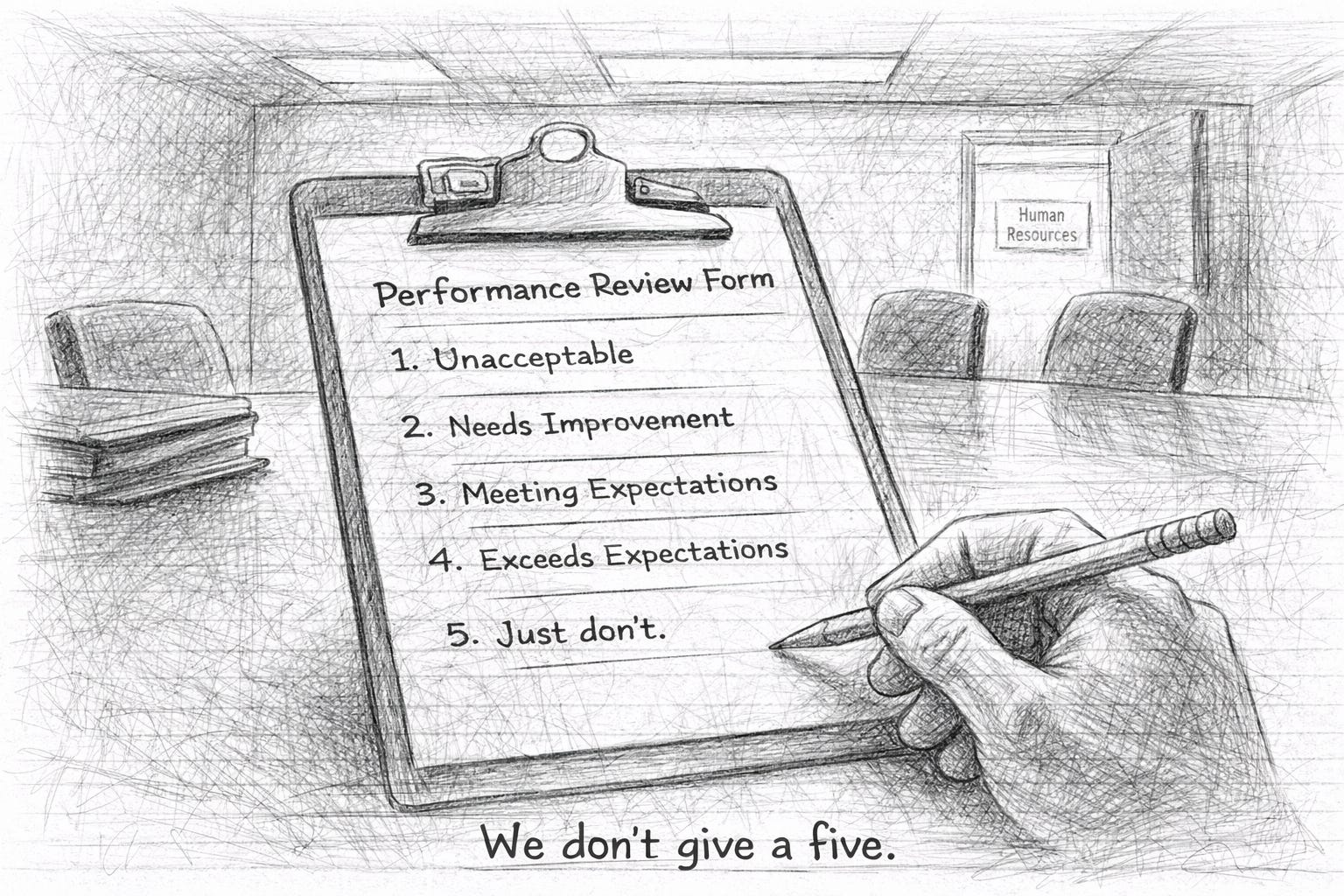
I was twenty-two, maybe twenty-three. Somewhere in there. Old enough to have a title, supervisor, I think, or maybe shift lead, young enough to be proud of it. They’d put me in a room with someone from human resources to learn how to give a performance review.
I remember the room better than I should. The table. The binder. The fluorescent light that buzzed just enough to notice if nobody was talking. I remember wanting to do it right. I’d been promoted because someone thought I was ready, and I intended to prove them correct. I had a legal pad. I was taking notes.
The scale, she explained, was one through five. One was unacceptable. Three was meeting expectations. Five was the best. Outstanding. The kind of employee you build around.
And then she said it.
We never give a five.
She didn’t pause. She didn’t frame it as a suggestion or a preference. It was policy delivered as common sense. No matter how good someone is, we never give them the top score. Because — and I remember this part clearly — everyone needs room to grow.
I wrote it down. I didn’t argue. I was twenty-two. You don’t argue in that room. You’re being let in on how things work, and the price of admission is nodding.
But something about it sat wrong. Not loud wrong. Quiet wrong. The kind of wrong you file away without knowing where to put it.
It took years for the shape of it to come into focus.
I gave reviews. I followed the system. I had people working for me who were genuinely excellent — the ones who showed up early, solved problems before you knew they existed, trained new hires without being asked. The kind of people who made everything around them work better. And I sat across from them and told them they were a four. Maybe a four-point-two. Because everyone needs room to grow.
You could see it land. Not as devastation — nobody cries over a four. But as a quiet deflation. A small, almost imperceptible adjustment of expectations. Oh. Okay. I thought I was doing everything right, but I guess there’s still something. They didn’t usually ask what the something was. And I couldn’t have told them if they had. Because there was nothing. They were excellent. The system just didn’t have a way to say so.
After a while, I started to understand what the instruction actually meant. It wasn’t about growth. It wasn’t about humility, motivation, or keeping people hungry. It was about position. A five means you’ve arrived. A five means you might feel entitled to something, a raise, a promotion, a question about why the person above you has the job and you don’t. A five is dangerous. Not to the employee. To the structure.
A four keeps you reaching. And reaching people doesn’t make demands. A four keeps you in place.
I left that job a long time ago. I’ve had a dozen jobs since then (if only), in kitchens, offices, stadiums, and catering trucks. Different industries. Different scales. But the same instruction, wearing different clothes.
The restaurant where the sous chef was always almost ready to run his own kitchen. Just needs another six months. The school where the teacher was rated effective but not yet highly effective, year after year, by metrics designed to make highly effective almost unreachable. The company where the annual raise was two percent because that’s what the budget allowed, regardless of what the work deserved.
Room to grow.
It’s the gentlest weapon in the architecture. It doesn’t say no. It says not yet. And not yet, repeated enough times, across enough years, in enough rooms with fluorescent lights and binders and someone from HR explaining how things work — not yet becomes never. Not with a door slamming. With a door that simply never opens all the way.
I wrote something on Monday about eight promises a president made eighty-two years ago. Promises that generated systems, and systems that were captured by the people they were supposed to regulate. That piece was about the architecture — the big picture, the pattern across institutions, the way the whole thing holds together.
This is smaller than that. This is one room. One sentence. Five words.
But I think the big architecture and the small architecture are the same thing. The system that keeps minor league players below the poverty line while their teams are worth billions is the same system that keeps a good employee at a four. The mechanism is different. The logic is identical. Don’t let them arrive. Don’t let them feel entitled to the thing they’ve earned. Keep them reaching. Reaching people are easier to manage than people who know what they’re worth.
We never give a five.
I think about that room sometimes. I’m not angry about it. I was angry for a while, the way you get angry at something once you finally have the language for it. But that faded into something else. Something closer to recognition.
That was the first time I saw the architecture. I just didn’t know what I was looking at yet.
I do now.
Tim Brice is a chef, author, and the creator of Big Ideas With Tim — a platform that examines how closed systems protect the people at the top at the expense of everyone else. His first book, The Diamond Pyramid: Saving American Baseball by Breaking It, is available now. He writes about systems every Monday, food every Sunday, and thinks out loud on Thursdays. This isn't about left or right. It's about who's up and who's down.